You know the word καφές. You have seen it on menus and practised saying it. At the café, though, you hesitate: which syllable should be stronger?
This Greek pronunciation guide focuses on Modern Greek, the language spoken in Greece today. You will practise word stress, notice a few sounds that English spelling can make confusing, and try a short pronunciation exercise. You can start with the section that matches what you find difficult.
If you are still learning the letters, our guide to reading Greek covers that first step in more detail.
Start with word stress: follow the Greek accent mark
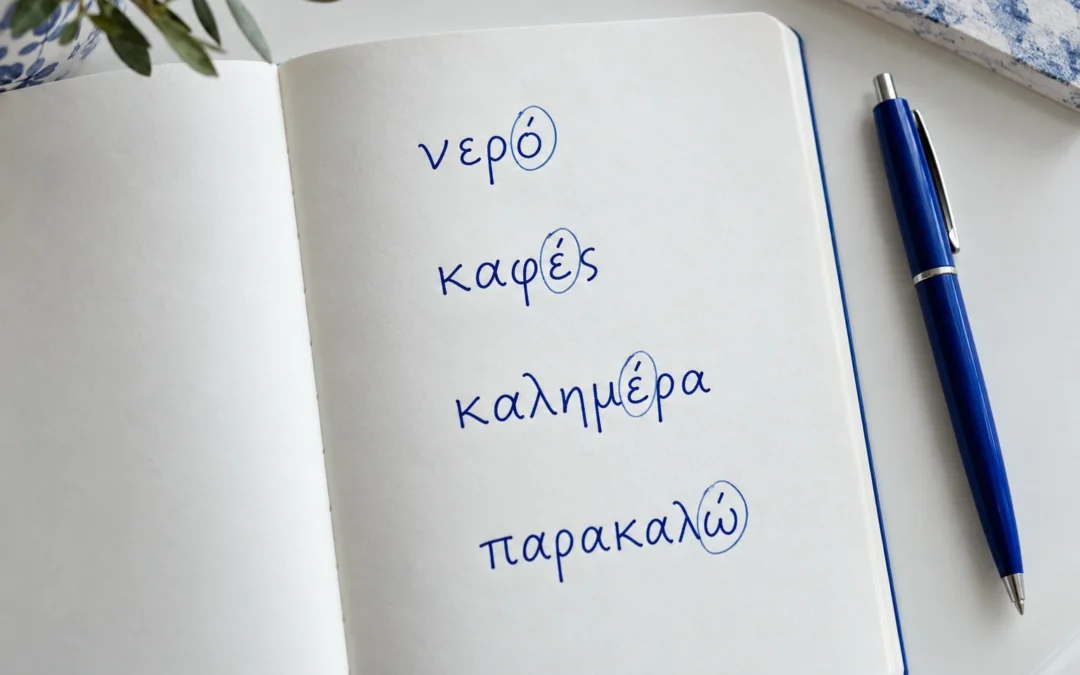
The small mark above a vowel is called ο τόνος, the tonos. It shows you which syllable to stress. In ordinary Modern Greek writing, words with two or more syllables normally carry this mark.
Say these words, giving a little more emphasis to the syllable in bold:
- νερό — water
- καφές — coffee
- καλημέρα — good morning
- παρακαλώ — please; also “you’re welcome”, depending on the situation
Keep the other syllables audible. You are giving one syllable more prominence, rather than shouting it or stopping before it.
Can moving the stress change the meaning?
Yes. Compare πότε; (“when?”) with ποτέ (“never”, in a negative statement).
Πότε πίνεις καφέ;
When do you drink coffee?
Δεν πίνω ποτέ καφέ.
I never drink coffee.
The spelling gives you the clue. When you learn a new word, learn its stress along with its meaning. For words spoken on their own, the stress falls within the last three syllables; that tells you the possible positions, but you still need the accent or a spoken model to choose the right one.
Why is the accent sometimes on the second letter?
In a vowel pair such as εί in είμαι (“I am”), the accent is written on the second letter. The pair represents one vowel sound, so you stress the syllable containing that sound. A diaeresis, the two dots in a spelling such as αϊ, signals that the vowels are read separately.
Avoid reading Greek letters as English letters
A familiar shape can lead you to the wrong sound. Three useful reminders are:
- Β β has the /v/ sound in “very”. Try βάζο — vase.
- Ρ ρ is an r sound, usually tapped or rolled, rather than English p. You meet it in νερό.
- Η η represents /i/, approximately the vowel in “see”. Try ήλιος — sun.
The names you learnt for Greek letters in maths may also differ from their Modern Greek pronunciation. Use examples from the language you want to speak.
Recognise letter combinations before saying the word
In Modern Greek, two written letters can work together. For example, αι represents /e/, while ει and οι represent /i/. The pair ου represents /u/, approximately the vowel in “food”. The slashes here indicate sounds, not English spelling.
The combinations αυ and ευ have two pronunciations:
- αύριο — tomorrow: αυ sounds /av/.
- αυτό — this: αυ sounds /af/.
- Εύα — Eva: ευ sounds /ev/.
- ευχαριστώ — thank you: ευ sounds /ef/.
The /v/ version occurs before a vowel or voiced consonant. The /f/ version occurs before a voiceless consonant, such as τ or χ. Start with these four examples and listen for the contrast when you encounter the words.
A short Greek pronunciation exercise
Read the words below. Decide which syllable you would stress, then say the whole word without a pause between its syllables.
- σήμερα — today
- ελληνικά — Greek, the language
- ευχαριστώ — thank you
- σκέτο — plain; without sugar when describing coffee
Check the stressed syllables
- σήμερα — the first syllable.
- ελληνικά — the final syllable.
- ευχαριστώ — the final syllable. The opening ευ sounds /ef/.
- σκέτο — the first syllable.
What should you practise next?
Choose the next step according to what is causing difficulty.
If you are still decoding letters: use our beginner’s reading guide. For a guided sequence with video lessons, listening activities and workbook practice, My Doorway to Greek covers the alphabet, pronunciation and reading. It is a foundation course, rather than a complete A1 programme.