

A family argues over an inherited house. Someone admits that they can never resist dessert. A conversation brings up an old disagreement, and suddenly everyone has something to say.
In Greek, each of these situations can be described through a myth.
The house becomes το μήλον της Έριδος, the apple of Eris, known in English as “the apple of discord”. Desserts are someone’s αχίλλειος πτέρνα, their Achilles’ heel. The conversation may ανοίξει το κουτί της Πανδώρας, open Pandora’s box.
You may recognise some of these expressions from English. Learning how they work in Greek gives you a way to understand both the stories and the conversations in which people still use them.
Η αχίλλειος πτέρνα — Achilles’ heel
You can be very good at something and still have one weakness.
That is what η αχίλλειος πτέρνα describes: a vulnerable point in a person, a plan or even an organisation.
Achilles was the great warrior of the Trojan War. In a later version of his story, his mother, Thetis, dipped him into the River Styx to protect him from harm. She held him by the heel, leaving that part untouched by the water and therefore vulnerable. This familiar account belongs to the later mythological tradition; it is not told in Homer’s Iliad. [1]
Today, you might hear:
«Τα γλυκά είναι η αχίλλειος πτέρνα μου.»
“Desserts are my Achilles’ heel.”
The speaker is admitting a weakness, perhaps with a smile. In a more serious context, the same expression could describe the flaw that puts an otherwise strong business or project at risk.
The word πτέρνα means “heel”. It is a more formal word than φτέρνα, which you will usually hear when someone talks about the actual part of the body.
Το μήλον της Έριδος — The Apple of Eris
Imagine two siblings who both want the same family house. The property becomes the reason for their arguments.
In Greek, you could say:
«Το πατρικό σπίτι έγινε το μήλον της Έριδος ανάμεσα στα δύο αδέλφια.»
“The family home became a source of conflict between the two siblings.”
The expression takes us to the wedding of Peleus and Thetis.
Eris, the goddess of discord, threw an apple into the gathering. Hera, Athena and Aphrodite each claimed it. Paris was asked to judge between them, and he chose Aphrodite, who had promised him Helen. Their dispute became part of the chain of events leading to the Trojan War. [2]
Το μήλον της Έριδος literally means “the apple of Eris”, referring to the goddess. Its English equivalent is “the apple of discord”. The expression describes the thing—or sometimes the person—that becomes the object of a dispute.
You may notice μήλον rather than μήλο, the ordinary modern Greek word for “apple”. This older form survives inside the fixed expression. You would still ask for ένα μήλο at the market. For help reading the Greek examples, see our beginner’s guide to reading Greek.
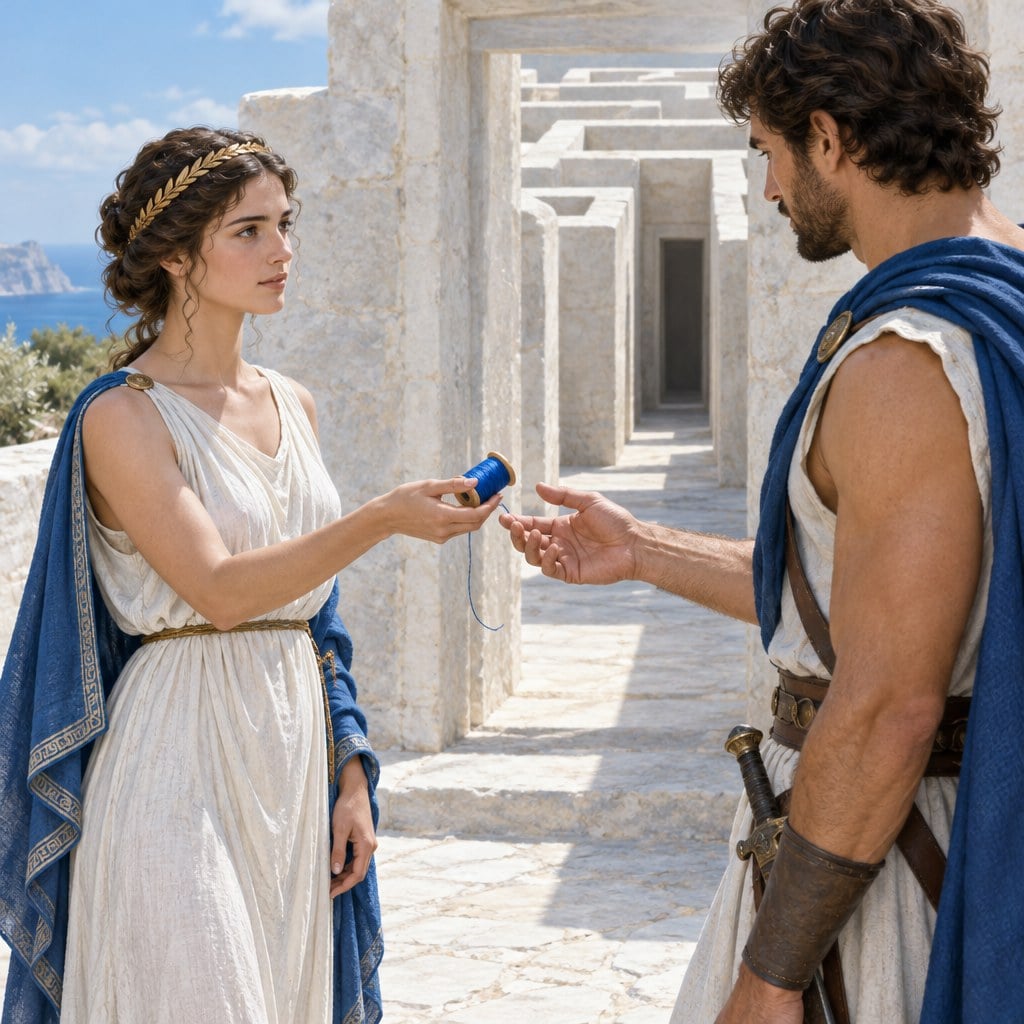
Ο μίτος της Αριάδνης — Ariadne’s thread
Some problems are difficult because you cannot see how the pieces connect. One detail can help you find your way through them.
Greek has an expression for that guiding clue: ο μίτος της Αριάδνης.
Ariadne helped Theseus enter the Labyrinth in Crete, where the Minotaur lived. She gave him a thread that would allow him to retrace his route and find the way out after killing the creature. Plutarch recounts her help in his Life of Theseus. [3]
The thread offers a clear image for understanding a complicated situation:
«Ένα παλιό γράμμα έγινε ο μίτος της Αριάδνης για να καταλάβουμε την ιστορία της οικογένειας.»
“An old letter became the clue that helped us make sense of the family’s history.”
Μίτος means “thread”, although κλωστή is the more familiar everyday word.
This expression has a more literary tone. You are more likely to encounter it in an article, a discussion or a thoughtful explanation than in a quick exchange at a shop.
Από τη Σκύλλα στη Χάρυβδη — Out of one danger and into another
Sometimes you leave a difficult situation only to discover that the alternative brings another problem.
Από τη Σκύλλα στη Χάρυβδη describes that unhappy move.
In Book 12 of the Odyssey, Odysseus must navigate between two dangers. Scylla is a monster that seizes sailors from passing ships. Charybdis swallows and releases the sea, creating a terrifying whirlpool. Avoiding one brings the ship closer to the other. [4]
The expression can describe situations far removed from a dangerous sea voyage:
«Έφυγε από μια δουλειά με εξαντλητικό ωράριο και βρέθηκε σε άλλη με ακόμη χειρότερες συνθήκες. Από τη Σκύλλα στη Χάρυβδη.»
“She left a job with exhausting hours and ended up in another with even worse conditions. Out of the frying pan and into the fire.”
The English expression is a useful equivalent here. Both describe an attempt to escape trouble that leads to further trouble.
Το κουτί της Πανδώρας — Pandora’s box
A question seems simple enough. You ask it, and it brings up disagreements that have been building for years.
That question has ανοίξει το κουτί της Πανδώρας.
In Hesiod’s Works and Days, Pandora opens a large jar, releasing troubles into the human world. Hope remains inside. The ancient account describes a jar rather than the box familiar from the modern expression. [5]
Today, opening Pandora’s box means setting off a series of problems that may be difficult to control.
«Η συζήτηση για τα οικογενειακά έξοδα άνοιξε το κουτί της Πανδώρας.»
“The discussion about the family’s expenses opened Pandora’s box.”
Perhaps the conversation began with an electricity bill and ended with years of complaints about who pays for what.
The expression draws attention to the consequences of opening up an issue. Once the discussion has begun, closing it again may be much harder than expected.
How to recognise these expressions in Greek
These five expressions do not all have the same tone. Η αχίλλειος πτέρνα can fit a lighthearted admission. Ο μίτος της Αριάδνης often sounds more literary. Others appear in journalism or in conversations where someone wants to describe a situation vividly.
Start with one whose story you already know. Read the Greek example aloud, then think of a situation in your own life where it would fit.
You might describe your weakness for chocolate, a disagreement over holiday plans or the clue that helped you understand a confusing document. Connecting an expression with a specific situation makes its meaning easier to remember.
The next time you hear someone mention η αχίλλειος πτέρνα or το κουτί της Πανδώρας, notice what they are describing. A weakness, a family disagreement, an awkward conversation: the setting may be ordinary, but the expression brings a whole story into it.
For guided practice with Greek letters and pronunciation, explore My Doorway to Greek, our self-paced course for complete beginners.
Sources and further reading
The mythological accounts above draw on ancient texts available in English translation through the Theoi Classical Texts Library:
- Statius, Achilleid, Book 1 — Achilles and the River Styx.
- Apollodorus, Library, Epitome 3.2 — the apple of Eris and the judgement of Paris.
- Plutarch, Life of Theseus, §19 — Ariadne’s thread and the Labyrinth.
- Homer, Odyssey, Book 12 — Scylla and Charybdis.
- Hesiod, Works and Days, lines 90–105 — Pandora and the jar.