
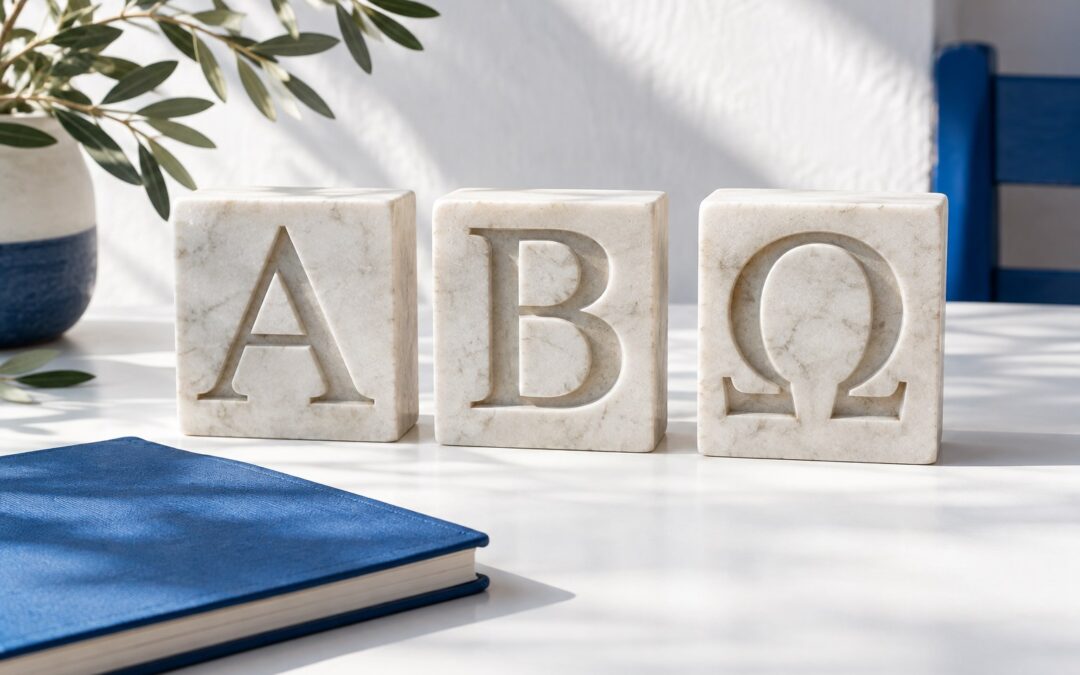
You may have met “π” in a maths lesson or seen “Ω” on an electrical device long before reading your first Greek word. The number π, approximately 3.14, connects a circle’s circumference with its diameter. “Ω” represents the ohm, the unit of electrical resistance.
These familiar symbols are also letters that Greek speakers use every day.
But why does the Greek alphabet have two letters for /o/? What happened to the letter that looked like “F”? And how did άλφα (alpha) and βήτα (beta) give their names to the word alphabet?
A few stories behind the letters can make the Greek alphabet feel much more familiar.
What made the Greek alphabet special?
The Greek alphabet systematically used separate letters for both consonants and vowels. This is why scholars often describe it as the first “true” or complete alphabet, distinguishing it from earlier systems that recorded consonants without separate vowel letters. [1]
Think of the English words bat, bet and bit. The consonants stay the same, but changing the vowel changes the meaning.
Giving vowels their own letters allowed Greek writers to record this essential information. It was an important development in the history of writing—and vowels remain central to every Greek word you learn today.
Άλφα and βήτα: a name you already know
The word alphabet comes from άλφα (alpha) and βήτα (beta), the names of the first two Greek letters: “Α” and “Β”. [2]
So even when you talk about the English alphabet, you are using a word formed from Greek letter names.
The letters themselves may look familiar, although their sounds can surprise you. In modern Greek, “Β” represents /v/, as in the English word very. Knowing the shape is a useful beginning; learning its Greek sound helps you read.
Ο μικρόν and Ω μέγα: the two letters for /o/
Greek has two letters that represent /o/ today: “Ο” and “Ω”. Their names become easier to understand when we separate the parts:
- ο μικρόν (omicron) means “small o”.
- ω μέγα (omega) means “big o”.
These expressions gave us the names όμικρον (omicron) and ωμέγα (omega). [3]
In Classical Greek, the letters represented different sounds: “ο” was a short /o/, while “ω” was a longer, more open /ɔː/. The mark /ː/ tells us that the vowel lasted longer. [4]
Today, that distinction has disappeared from pronunciation. In νερό (water) and εδώ (here), the final vowel has the same sound, even though the words end with different letters.
This explains something many beginners notice: Greek spelling sometimes keeps a piece of the language’s history that we no longer hear.
The letter that disappeared: δίγαμμα
The Greek alphabet once included δίγαμμα (digamma), written “Ϝ”.
It looks rather like a Latin “F”, but it represented /w/, as in the English word water. Its name means “double gamma”, describing a shape that resembles two gamma forms joined together. [5]
As /w/ disappeared from much of spoken Greek, the letter gradually fell out of everyday spelling.
Other older letters, including σαν (san) and κόππα (koppa), also disappeared from ordinary alphabetic use. [6] The 24 letters we learn today are the result of a long history of changes.

From familiar symbols to your first Greek words
The history of the Greek alphabet can help you look at its letters differently.
“π” belongs in πόρτα (door) as well as in a maths lesson. “Ω” appears in ώρα (hour) as well as on electrical equipment. These are working letters in a living language.
You do not need to memorise their history to begin reading. Start with a few letters, notice them in real words, and listen to how those words sound.
To put those letters into practice, our How to Read Greek: A Beginner’s Guide introduces modern letter sounds, common combinations and word stress, with a short reading exercise you can try.
If you would like some guidance, My Doorway to Greek introduces the modern Greek alphabet, pronunciation and reading, helping you take those first steps.
Sources and further reading
- Willemijn Waal — The Greek Alphabet: Older Than You May Think?
- Oxford Learner’s Dictionaries — Alphabet: word origin
- Barry B. Powell — Writing: Theory and History of the Technology of Civilization (PDF excerpt)
- The Cambridge Grammar of Classical Greek — §§1.15–1.18 (PDF preview)
- Herbert Weir Smyth — Greek Grammar, §3
- Ignace J. Gelb — A Study of Writing, University of Chicago Press
Trackbacks/Pingbacks